For those living at higher elevations, the simple act of cooking rice can often turn into a frustrating culinary challenge. The dream of perfectly fluffy, tender grains can quickly dissipate into a reality of either mushy or undercooked rice. If you’ve ever wondered why your tried-and-true sea-level rice recipes fail in the mountains, you’re not alone. The unique atmospheric conditions of high altitudes require a specialized approach to cooking, and thankfully, modern rice cookers are stepping up to the plate. This comprehensive guide will explore the science behind high-altitude cooking and introduce you to the best rice cookers engineered to deliver flawless rice, no matter how high you climb.
Understanding High Altitude Rice Cooking Challenges
The primary reason rice cooking becomes complicated at high altitudes is atmospheric pressure. As elevation increases, atmospheric pressure decreases. This lower pressure has two significant effects on cooking water, which in turn impacts your rice:
Firstly, water boils at a lower temperature. While water boils at 212°F (100°C) at sea level, it boils at approximately 203°F (95°C) at 5,000 feet and even lower, around 198°F (92°C), at 7,000 feet. Since rice cooks by absorbing hot water, this reduced temperature means the grains don’t reach the necessary heat for proper starch gelatinization and softening.
Secondly, the lower boiling point also leads to faster evaporation of water. This combination of lower cooking temperature and quicker moisture loss means your rice often ends up undercooked, dry, or with an unappeven texture. The grains might still be hard even after all the water has been absorbed, leaving you with less-than-ideal results.
How Rice Cookers Conquer High Altitude Cooking
Traditional stovetop methods often require significant adjustments in water ratios and cooking times at high altitudes. While basic rice cookers offer convenience, specialized models integrate advanced technologies to automatically compensate for elevation, ensuring consistent results.
Mechanical Rice Cookers: The Basic Approach
|
Our Picks for the Best Rice Cooker in 2026
As an Amazon Associate I earn from qualifying purchases.
|
||
| Num | Product | Action |
|---|---|---|
| 1 | AROMA® Select Stainless® Rice Cooker, 3-Cup (Uncooked) / 6-Cup (Cooked), Stainless Steel Inner Pot, Small Rice Cooker, Auto Keep Warm, 1.2 Qt, White, ARC-753SG |

|
| 2 | AROMA® Mini Rice Cooker, 2-Cup (Uncooked) / 4-Cup (Cooked), Grain Cooker, Soup Maker, Oatmeal Cooker, Auto Keep Warm, 1 Qt, Light Green |
|
| 3 | BLACK+DECKER Rice Cooker 6-Cup (Cooked) with Steaming Basket, Removable Non-Stick Bowl, White |
|
| 4 | Zojirushi Micom 3-Cup Compact Size, Multiple Settings, Stainless Steel Made, Built-In Retractable Power Cord and Easy to Transport Rice Cooker and Warmer |
|
| 5 | COMFEE' Compact Rice Cooker, 6-in-1 Stainless Steel Multi Cooker, Slow Cooker, Steamer, Saute, and Warmer, 2 QT, 8 Cups Cooked(4 Cups Uncooked), Brown Rice, Quinoa and Oatmeal, 6 One-Touch Programs |
|
| 6 | COSORI Rice Cooker 10 Cup, 24h Keep Warm, Non-stick Ceramic Inner Pot, 18 Functions Fuzzy Logic Rice Maker with Stainless Steel Steamer Basket, Sauté, Slow Cooker, Black |
|
| 7 | AROMA® Mini Rice Cooker, 2-Cup (Uncooked) / 4-Cup (Cooked), Grain Cooker, Soup Maker, Oatmeal Cooker, Auto Keep Warm, 1 Qt, Milk Tea color |
|
| 8 | Instant Pot 4QT RIO Mini 7-in-1 Multi-Cooker, Pressure Cooker, Slow cook, Sauté, Steam, Rice Maker, Yogurt, & Warmer, Sea Salt, 4 Quarts |
|
| 9 | AROMA Digital Rice Cooker, 4-Cup (Uncooked) / 8-Cup (Cooked), Steamer, Grain Cooker, Multicooker, 2 Qt, Stainless Steel Exterior, ARC-914SBD |
|
| 10 | Aroma Housewares 4-Cups (Cooked) / 1Qt. Rice & Grain Cooker (ARC-302NGBL), Blue |
|
Mechanical or conventional rice cookers are the simplest type, operating on a straightforward principle: they heat water until it boils and then switch to a “keep warm” mode once the water has been absorbed or evaporated and the temperature rises above the boiling point. At high altitudes, where water boils at a lower temperature, these cookers might prematurely switch off, leaving the rice undercooked. To use them effectively at elevation, you’ll generally need to add more water and potentially extend the cooking time manually by allowing the rice to steam longer in “keep warm” mode.
Micom and Fuzzy Logic Rice Cookers: Smart Adjustments
Micom, or microcomputerized, rice cookers represent a significant upgrade. Equipped with a microchip and thermal sensors, these “fuzzy logic” models can “think” and make minor adjustments to cooking time and temperature throughout the cooking cycle. They adapt to varying amounts of rice and water, and to some extent, environmental factors like ambient temperature. For high-altitude cooking, fuzzy logic can offer improved results over basic models, as their ability to sense and adapt helps counter some of the atmospheric challenges. However, for very high elevations, they may still require slight manual water adjustments to achieve perfection.
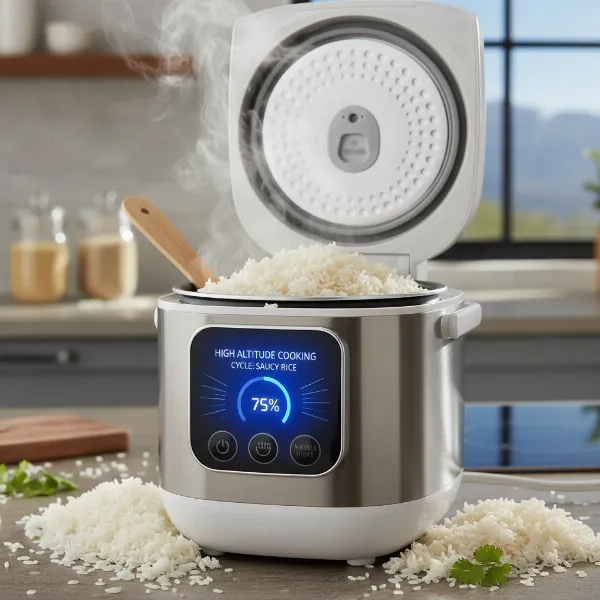 A smart fuzzy logic rice cooker preparing rice for optimal texture at high altitude.
Induction Heating (IH) Rice Cookers: Precision Heat
Induction Heating (IH) technology is a game-changer for precise cooking. Instead of a heating element at the bottom, IH rice cookers use electromagnetic fields to heat the entire inner pot directly and uniformly. This even heat distribution prevents hot spots and ensures that every grain of rice cooks consistently. When combined with fuzzy logic, IH cookers offer superior temperature control, making them highly effective at maintaining the necessary cooking temperature for thorough grain hydration, even when the boiling point is lower due to altitude.
Pressure Induction Heating (PIH) Rice Cookers: The Ultimate Solution
For those living at significant elevations, Pressure Induction Heating (PIH) rice cookers are often considered the ultimate solution. These advanced models combine the benefits of pressure cooking, induction heating, and fuzzy logic microcomputer technology. Pressure cooking raises the boiling point of water within a sealed environment, effectively mimicking sea-level conditions and ensuring that rice cooks thoroughly and quickly. When this is coupled with the precise, even heating of IH and the adaptive intelligence of fuzzy logic, PIH rice cookers can overcome virtually all high-altitude cooking challenges, consistently delivering perfectly cooked, fluffy rice. Many expert chefs and high-altitude residents swear by these models for their unparalleled performance.
Key Features to Look for in a High Altitude Rice Cooker
Choosing the right rice cooker for high altitude cooking involves understanding which features directly address the unique challenges of your environment.
Pressure Cooking Functionality
This is arguably the most crucial feature for high-altitude cooking. A pressure rice cooker creates an airtight seal, building internal pressure that raises the boiling point of water. This allows rice to cook at a higher temperature, countering the effect of lower atmospheric pressure and ensuring the grains absorb moisture fully and cook evenly, leading to perfectly tender rice in less time.
Fuzzy Logic Technology
Look for rice cookers equipped with fuzzy logic or AI (Artificial Intelligence) capabilities. These smart cookers use sensors to detect the precise temperature and moisture levels, automatically adjusting cooking time and heat intensity. This adaptive intelligence is invaluable at altitude, as it can compensate for the lower boiling point and faster evaporation rates, optimizing the cooking process for consistent results.
Induction Heating (IH)
Induction Heating ensures that the entire inner pot heats quickly and uniformly, rather than just from the bottom. This even heat distribution is vital for preventing undercooked spots and achieving a consistently fluffy texture across all grains, regardless of the fluctuating ambient conditions at higher elevations.
Capacity and Size
Consider your household size and how often you cook rice. Rice cookers come in various capacities, typically measured in cups of uncooked rice (e.g., 3-cup, 5.5-cup, 10-cup).
- Small (under 1 liter / 3-cup): Ideal for 1-2 people.
- Medium (1-1.8 liters / 5.5-10 cup): Suitable for families of 3-5.
- Large (over 1.8 liters / 10+ cup): Best for larger families or entertaining.
Preset Programs and Versatility
Many advanced rice cookers offer specialized settings for different types of grains (white, brown, sweet, sushi, GABA rice) and even other cooking functions like steaming vegetables, making porridge, or baking cakes. These preset programs are often optimized for specific grain characteristics, and in fuzzy logic or pressure models, they can be further fine-tuned by the cooker’s intelligence to perform optimally at your altitude.
Top Recommended Rice Cooker Brands for High Altitude
When it comes to mastering high-altitude rice cooking, certain brands stand out for their advanced technology and reliable performance.
Zojirushi: This Japanese brand is a consistent favorite among rice enthusiasts and is particularly well-regarded for its high-tech offerings. Their Neuro Fuzzy, Induction Heating (IH), and especially their Pressure Induction Heating (PIH) models are excellent choices. Zojirushi’s pressure rice cookers are specifically designed to perform well up to 5,000 feet, and many users report great success even at higher elevations by slightly adjusting water levels. Their advanced models precisely control temperature and pressure, ensuring thorough cooking and perfect texture.
Cuckoo: A leading South Korean brand, Cuckoo specializes in high-end, multi-functional pressure rice cookers. These appliances often come with voice navigation, numerous cooking modes, and robust pressure cooking capabilities that make them highly effective at overcoming high-altitude challenges. Cuckoo models are known for their durability and ability to produce excellent rice, including special settings for germinated brown rice (GABA).
While Zojirushi and Cuckoo are top contenders, other brands like Tiger also offer competitive IH and pressure rice cooker options that can perform admirably at higher elevations. For those on a tighter budget, some Aroma Housewares or Instant Pot models might offer decent results, though they may require more manual adjustment and experimentation.
High Altitude Rice Cooking Tips (Even with a Specialized Cooker)
Even with the most advanced rice cooker, a few simple tips can help you achieve consistently perfect rice at high altitudes.
The most common adjustment is to increase your water-to-rice ratio. At altitudes between 3,000 and 5,000 feet, you might add an extra ⅛ to ¼ cup of water per cup of rice. For elevations above 5,000 feet, this could increase to 10-15% more water than a sea-level recipe. Experiment to find your ideal ratio. For example, if a recipe calls for 1 cup of rice to 1.75 cups of water at sea level, you might use 1 cup of rice to 1.875 or 2 cups of water at higher altitudes.
Consider pre-soaking your rice for 20-30 minutes before cooking. This allows the grains to absorb some water beforehand, shortening the actual cooking time required and helping them cook more evenly in the high-altitude environment.
Finally, embrace a bit of trial and error. Start with small adjustments to water and cooking settings based on your elevation and specific rice cooker model. Keep a log of your successful ratios and settings. The “keep warm” function on many rice cookers can also be your friend; if rice seems slightly undercooked after the cycle finishes, letting it rest longer in “keep warm” mode can allow residual heat and steam to complete the cooking process. Avoid lifting the lid too often during cooking, as this releases precious steam and heat.
Comparison Table: Rice Cooker Types for High Altitude
| Feature | Conventional/Mechanical | Micom/Fuzzy Logic | Induction Heating (IH) | Pressure IH Micom |
|---|---|---|---|---|
| High Altitude Performance | Poor, requires significant manual adjustment | Fair, some adaptation, may need manual water adjustment | Good, precise heat helps, still benefits from smart tech | Excellent, specifically designed to compensate for altitude |
| Price Range | Low | Medium | Medium-High | High |
| Technology | Simple thermostat | Microcomputer, sensors | Electromagnetic coils for heating | Pressure cooking, IH, Microcomputer |
| Heat Distribution | Bottom only | Bottom only, with intelligent control | Whole pot, even | Whole pot, even, plus pressure |
| Features | Basic cook/warm | Multiple grain settings, delay timer, textures | Advanced cooking options, consistent results | Highest precision, rapid cooking, advanced menu |
| Recommended Use | Occasional use at low altitude, or significant manual adjustment needed at high altitude | Good for intermediate users at moderate altitudes | Excellent for consistent results at moderate to high altitudes | Best for consistent, premium results at any high altitude |
Where to Purchase Your High Altitude Rice Cooker
Investing in a quality rice cooker for high altitude is a decision that pays off with every perfectly cooked meal. You can find these advanced appliances through several reliable channels:
Online Retailers: Large e-commerce platforms like Amazon, Best Buy, and specialty kitchen appliance sites often carry a wide selection of Zojirushi, Cuckoo, and other brands. Shopping online provides the convenience of comparing models, reading reviews, and often finding competitive prices. Be sure to check seller ratings and return policies.
Brick-and-Mortar Stores: Major electronics stores or home goods retailers may have a smaller selection but offer the advantage of seeing the appliance in person and speaking with sales associates. This can be helpful for understanding size and specific features.
Manufacturer Websites: Purchasing directly from brands like Zojirushi or Cuckoo ensures you get genuine products, access to their full range, and direct customer support and warranty services.
When buying, always confirm the warranty policy and the retailer’s return policy. Given the investment in higher-end models, having a robust warranty provides peace of mind. Also, consider customer reviews, especially those from other high-altitude users, for real-world performance insights.
Maintaining Your Rice Cooker for Longevity
Proper care and maintenance will ensure your high-altitude rice cooker continues to deliver perfect rice for years to come.
Cleaning Instructions: Always unplug the rice cooker before cleaning. The inner pot, typically non-stick, should be washed gently with warm, soapy water and a soft sponge. Avoid abrasive scrubbers or harsh detergents that can damage the non-stick coating. The inner lid and steam vent, especially on pressure models, should also be cleaned regularly to prevent clogs and ensure proper sealing. Wipe down the exterior body with a damp cloth, never immersing the main unit in water.
Care for the Inner Pot: The inner pot is crucial for cooking performance. To prevent scratches and damage to the non-stick surface, always use the plastic or wooden rice paddle provided (or similar non-metal utensils) to scoop rice. Avoid stacking heavy items inside the pot during storage. If the non-stick coating begins to wear or scratch significantly, consider replacing the inner pot if available from the manufacturer.
Troubleshooting Common Issues: If your rice isn’t cooking perfectly, check a few common culprits:
- Water Ratio: Double-check your water-to-rice ratio, especially for your specific altitude and rice type.
- Lid Seal: Ensure the lid is properly closed and sealed, particularly for pressure models.
- Inner Pot Placement: Make sure the inner pot is correctly seated in the cooker.
- Cleanliness: A dirty steam vent or inner lid can affect performance.
- Rice Type: Different rice types (e.g., brown rice vs. white rice) require different settings and cooking times.
Most modern rice cookers have built-in safety features and diagnostic indicators, so consult your user manual for specific troubleshooting tips for your model.
Conclusion
Living at high altitudes doesn’t mean sacrificing the joy of perfectly cooked rice. While the unique atmospheric conditions present challenges, the advancements in rice cooker technology offer effective and often automated solutions. From basic mechanical models that require manual adjustments to sophisticated Pressure Induction Heating (PIH) rice cookers that intelligently adapt to your elevation, there’s a perfect appliance for every need and budget. By understanding the science, choosing a cooker with appropriate features like pressure cooking and fuzzy logic, and applying a few simple cooking tips, you can ensure consistently fluffy, delicious rice every time. Embrace the innovation and elevate your high-altitude cooking experience.
Are you ready to transform your high-altitude kitchen into a hub of culinary success?
Frequently Asked Questions About High Altitude Rice Cooking
What is the ideal water-to-rice ratio for white rice at 6,000 feet elevation?
At 6,000 feet, water boils at a lower temperature and evaporates faster. A good starting point is to add an extra ⅛ to ¼ cup of water for every cup of white rice compared to sea-level recipes. For example, if a recipe calls for 1.75 cups of water per 1 cup of rice, try 1.875 to 2 cups of water. You may need slight adjustments based on your specific rice cooker and rice type.
Do I need a special “high altitude” rice cooker, or can I just adjust my existing one?
While you can often achieve better results with an existing basic or Micom rice cooker by increasing water and cooking time, dedicated pressure or advanced fuzzy logic/IH rice cookers are engineered to automatically compensate for altitude challenges, offering more consistent and effortless results without manual adjustments.
How does fuzzy logic help with high-altitude rice cooking?
Fuzzy logic rice cookers use internal sensors to monitor temperature and moisture, allowing them to make real-time adjustments to the cooking cycle. At high altitudes, this intelligence helps them adapt to the lower boiling point and faster evaporation, ensuring rice cooks thoroughly by extending cooking time or adjusting heat as needed, though extreme altitudes might still benefit from slight manual water tweaks.
Can I cook brown rice in a regular rice cooker at high altitude, and what changes should I make?
Cooking brown rice at high altitude in a regular rice cooker is possible but requires more attention. Brown rice naturally needs more water and a longer cooking time than white rice. At high altitude, you’ll need to increase the water by an additional ¼ to ½ cup per cup of brown rice and expect a longer cooking duration, potentially using the “keep warm” function for extended steaming after the main cycle.