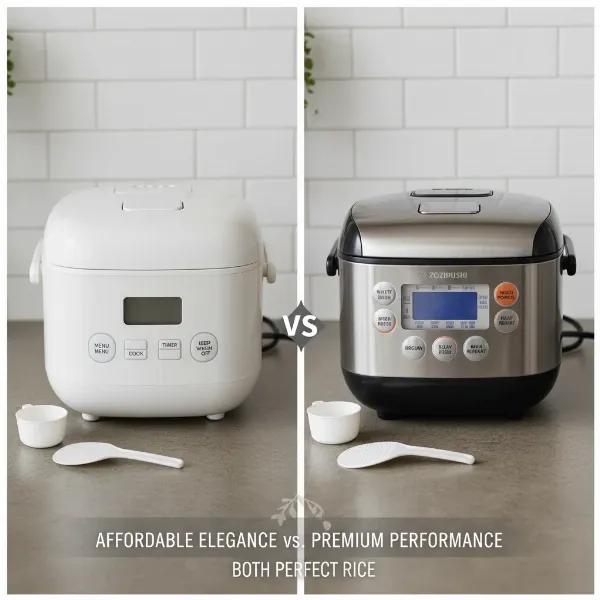
Imagine a world where preparing a simple bowl of rice demanded hours of meticulous attention, constant fire adjustments, and an almost intuitive understanding of heat and grain. For millennia, this was the reality for countless households across Asia, where rice is not just a meal but a cultural cornerstone. The journey from this laborious culinary art to the effortless “set-it-and-forget-it” convenience of today’s advanced rice cookers is a fascinating tale of innovation, engineering, and a relentless pursuit of culinary perfection. This evolution has not only transformed kitchens but has also profoundly impacted daily life, freeing up precious time and redefining the standard of perfectly cooked rice.
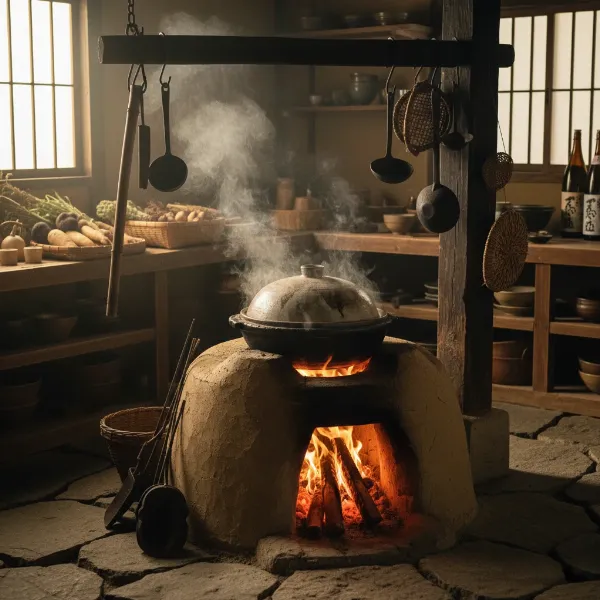 Ancient kamado stove with a traditional pot cooking rice over an open fire, surrounded by a rustic kitchen setting.
The Ancient Roots: Cooking Rice Over Wood Fires
Before the advent of electricity, rice preparation was a time-consuming ritual centered around traditional cooking methods. Across Asia, a prominent method involved the use of kamado stoves, large clay or ceramic ovens designed to hold substantial pots, often made of iron or earthenware. Cooking rice on a kamado required significant skill and constant supervision. Cooks had to master the delicate balance of heat, precisely adjusting the firewood to control the flame intensity. This manual process was so integral that specific rhymes, like the Japanese “Hajime choro choro, naka pappa, butsu butsu iu koro hi o hiite,” guided cooks through the stages of heating—starting low, increasing, then decreasing as the rice bubbled. This tradition of perfecting rice over wood fires was a core domestic responsibility, particularly for women, consuming many hours of their day to ensure the family’s staple food was cooked to perfection.
The Dawn of Electric Rice Cookers: Early Innovations
The idea of an electric appliance to simplify rice cooking emerged in the early 20th century, marking the first significant departure from traditional wood-fired methods. Mitsubishi Electric introduced one of the earliest electric rice cookers in Japan in 1923. However, these initial models were rudimentary and far from the automatic devices we know today. They were essentially heating elements encased in a pot, lacking any form of temperature regulation or automatic shut-off. This meant users still had to diligently monitor the cooking process to prevent burning, making them more of an electric heating device than a true “cooker.” Consequently, these early electric versions were not well-received for household use and saw limited commercial success. Other prominent Japanese companies, including Matsushita (now Panasonic) and Sony, also explored similar designs in the 1940s and early 1950s, but their attempts to create a user-friendly, automatic electric rice cooker were largely unsuccessful, highlighting the complex challenges involved in automating such a delicate culinary task.
The Automatic Revolution: Toshiba’s Breakthrough
The true breakthrough in rice cooker technology arrived in 1955 with Toshiba’s introduction of the ER-4, the world’s first commercially successful automatic electric rice cooker for home use. Developed by Shogo Yamada and made possible by Yoshitada Minami’s innovative design, this appliance sparked a profound “kitchen revolution.” The genius behind Toshiba’s design was a “double-pot indirect cooking” method. Rice and water were placed in an inner pot, which was then set inside a larger outer pot containing a measured amount of water. As the outer pot’s water evaporated, the temperature inside the cooker rapidly increased, triggering a bimetallic strip thermostat that automatically turned off the heating element. This simple yet revolutionary mechanism meant that for the first time, home cooks could simply add rice and water, press a button, and return later to perfectly cooked rice, without constant supervision. The Toshiba ER-4 dramatically reduced the domestic burden, particularly for women, who were freed from the arduous task of monitoring pots over open flames. Its immediate success led to rapid adoption across Japan, quickly becoming a staple in half of all Japanese households within just four years.
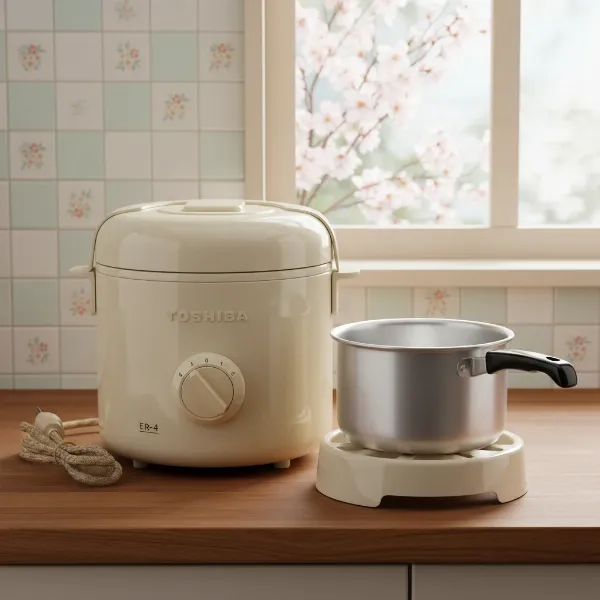 An antique Toshiba automatic electric rice cooker from the 1950s, featuring a simple, robust design.
The Era of Enhanced Functionality: From Keep Warm to Induction Heating
Following the initial success of automatic rice cookers, manufacturers continuously innovated, adding features that further enhanced convenience and cooking quality. The 1960s saw the introduction of essential functionalities like the “keep warm” setting and built-in timers, allowing users to schedule cooking and maintain rice at an optimal serving temperature for extended periods. This meant hot rice could be ready for breakfast simply by setting it the night before.
The 1970s brought significant advancements with the integration of microcomputer control. In 1979, the first “micro-controller jar rice cookers” emerged, capable of regulating soaking times and adjusting heat levels based on the volume and type of rice. This marked a shift towards more intelligent cooking, producing consistently better results.
A truly groundbreaking innovation occurred in 1988 with the debut of Induction Heating (IH) rice cookers. Unlike earlier models that heated from the bottom, IH technology used electromagnetic coils to heat the entire inner pot directly and more evenly. This superior heating method allowed for precise temperature control and generated higher, more consistent heat, resulting in rice with enhanced flavor and texture.
By 1992, pressure IH rice cookers further refined the cooking process, using pressurized environments to achieve even higher temperatures and deeper heat penetration. This innovation made it possible to perfectly cook a wider variety of grains, including brown rice and mixed grains, which are traditionally harder to prepare. Modern models now offer hundreds of cooking settings, catering to diverse preferences and culinary needs.
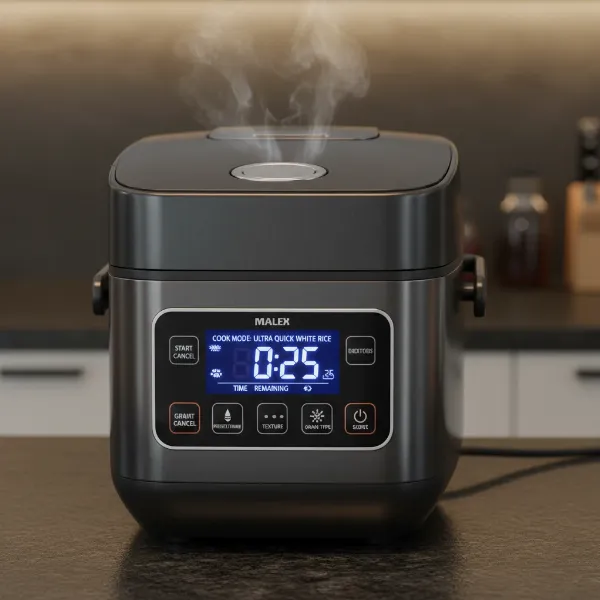 A sleek, modern induction heating (IH) rice cooker with a digital display and multiple function buttons, showcasing advanced technology.
The Smart Kitchen: AI and the Future of Rice Cookers
In the 21st century, the rice cooker has transcended its role as a simple kitchen appliance, evolving into a sophisticated, AI-powered culinary assistant. Today’s smart rice cookers leverage cutting-edge technology to offer unparalleled precision and convenience. Equipped with advanced sensors and microprocessors, these devices meticulously regulate temperature and moisture levels throughout the entire cooking cycle, ensuring every grain is cooked to perfection, free from being underdone or overcooked.
A key feature of these intelligent appliances is their adaptive learning capability. AI algorithms allow the rice cooker to learn from past cooking cycles and user preferences, automatically adjusting settings for future batches to deliver ideal results. This fuzzy logic approach, pioneered by companies like Hitachi in earlier decades, has now been amplified by powerful AI, allowing the cooker to account for variables such as rice type, water hardness, and even ambient kitchen conditions.
Some advanced AI cooking systems can go further, integrating features like cameras to identify rice types, automatically dispensing precise amounts of rice and water from integrated compartments, and even initiating the washing process. App connectivity has become common, enabling users to control their rice cooker remotely from their smartphones, ensuring a perfectly cooked meal is ready upon arrival home. Brands like Midea and Zojirushi are at the forefront of this wave, developing and patenting systems that promise a fully automated and personalized rice cooking experience, truly integrating the humble appliance into the fabric of the smart home.
“The fuzzy logic rice cooker is perhaps the most sophisticated use of advanced computing technology that most people will ever encounter in their daily lives. It’s artificial intelligence dedicated solely to the perfect grain of rice.” – Yuichiro Nakajima, Technology Historian
Conclusion
From the smoky charm of ancient wood-fired kamado stoves to the sleek, intelligent designs of today’s AI-powered machines, the rice cooker has undergone a remarkable transformation. What began as a labor-intensive chore has evolved into an effortless culinary experience, democratizing perfectly cooked rice for millions worldwide. Each advancement, from the first automatic shut-off mechanism to sophisticated Induction Heating and AI cooking algorithms, has built upon the last, reflecting humanity’s continuous quest for efficiency and culinary excellence. The rice cooker stands as a testament to how humble inventions can profoundly reshape daily life and cultural practices. As technology continues its rapid march forward, one can only anticipate what further innovations smart rice cookers will bring, making our kitchens even more intuitive and our meals even more delightful. What future culinary wonders will the next generation of rice cookers unveil?
Frequently Asked Questions
What was the first method of cooking rice?
|
Our Picks for the Best Rice Cooker in 2026
As an Amazon Associate I earn from qualifying purchases.
|
||
| Num | Product | Action |
|---|---|---|
| 1 | Zojirushi Micom 3-Cup Compact Size, Multiple Settings, Stainless Steel Made, Built-In Retractable Power Cord and Easy to Transport Rice Cooker and Warmer |

|
| 2 | AROMA® Select Stainless® Rice Cooker, 3-Cup (Uncooked) / 6-Cup (Cooked), Stainless Steel Inner Pot, Small Rice Cooker, Auto Keep Warm, 1.2 Qt, White, ARC-753SG |
|
| 3 | COSORI Rice Cooker 10 Cup, 24h Keep Warm, Non-stick Ceramic Inner Pot, 18 Functions Fuzzy Logic Rice Maker with Stainless Steel Steamer Basket, Sauté, Slow Cooker, Black |
|
| 4 | BLACK+DECKER Rice Cooker 6-Cup (Cooked) with Steaming Basket, Removable Non-Stick Bowl, White |
|
| 5 | AROMA® Mini Rice Cooker, 2-Cup (Uncooked) / 4-Cup (Cooked), Grain Cooker, Soup Maker, Oatmeal Cooker, Auto Keep Warm, 1 Qt, Light Green |
|
| 6 | Instant Pot 4QT RIO Mini 7-in-1 Multi-Cooker, Pressure Cooker, Slow cook, Sauté, Steam, Rice Maker, Yogurt, & Warmer, Sea Salt, 4 Quarts |
|
| 7 | AROMA Digital Rice Cooker, 4-Cup (Uncooked) / 8-Cup (Cooked), Steamer, Grain Cooker, Multicooker, 2 Qt, Stainless Steel Exterior, ARC-914SBD |
|
| 8 | COMFEE' Compact Rice Cooker, 6-in-1 Stainless Steel Multi Cooker, Slow Cooker, Steamer, Saute, and Warmer, 2 QT, 8 Cups Cooked(4 Cups Uncooked), Brown Rice, Quinoa and Oatmeal, 6 One-Touch Programs |
|
| 9 | Aroma Housewares 4-Cups (Cooked) / 1Qt. Rice & Grain Cooker (ARC-302NGBL), Blue |
|
| 10 | AROMA® Mini Rice Cooker, 2-Cup (Uncooked) / 4-Cup (Cooked), Grain Cooker, Soup Maker, Oatmeal Cooker, Auto Keep Warm, 1 Qt, Milk Tea color |
|
The earliest methods of cooking rice involved traditional kamado stoves, which were large clay or ceramic ovens. These required manual control of firewood and water to cook rice over an open flame, a process that was both skilled and time-consuming.
Who invented the first automatic electric rice cooker?
The first commercially successful automatic electric rice cooker for home use, the ER-4, was introduced by Toshiba in 1955. Key figures in its development were Shogo Yamada and Yoshitada Minami, who designed the innovative “double-pot indirect cooking” system with an automatic shut-off.
What is “fuzzy logic” in a rice cooker?
Fuzzy logic in a rice cooker refers to advanced programming that allows the appliance to make intelligent adjustments to cooking parameters. It adapts to variables like the type and quantity of rice, water hardness, and ambient temperature, optimizing the cooking cycle for consistently perfect results, a precursor to modern AI.
How does an Induction Heating (IH) rice cooker work?
An Induction Heating (IH) rice cooker uses electromagnetic fields to heat the entire inner pot directly, rather than just from a heating plate at the bottom. This method ensures more even and rapid heat distribution, leading to more precise temperature control and, ultimately, better-tasting, perfectly cooked rice.
What advanced features do AI-powered rice cookers offer?
Modern AI-powered rice cookers offer a suite of advanced features, including precision temperature and moisture regulation through sensors and microprocessors, adaptive learning to customize cooking based on user preferences, and even automated functions like measuring and dispensing rice and water. Many also integrate app connectivity for remote control and monitoring.