Few kitchen appliances offer the simple convenience of a rice cooker. It’s a reliable workhorse, effortlessly transforming dry grains into perfectly fluffy rice with the press of a button. However, when your trusty rice cooker suddenly refuses to power on, it can quickly disrupt your meal plans and leave you staring at an unlit control panel. This guide will walk you through the most common reasons why your rice cooker might not be turning on and provide clear, step-by-step troubleshooting solutions to diagnose and fix the problem. You don’t always need a new appliance; often, a few simple checks can bring your rice cooker back to life.
Understanding Why Your Rice Cooker Won’t Turn On
A rice cooker that won’t turn on typically indicates an interruption in its power supply or an internal component malfunction. Recognizing these underlying issues is the essential first step in effective diagnosis and resolution. Many users initially suspect major failures, but often, the cause is surprisingly simple. By methodically checking each potential culprit, you can often save yourself the hassle and expense of replacing a perfectly repairable appliance. This troubleshooting process empowers you to understand the basic mechanics of your rice cooker and pinpoint exactly where the fault lies, ensuring your kitchen remains efficient.
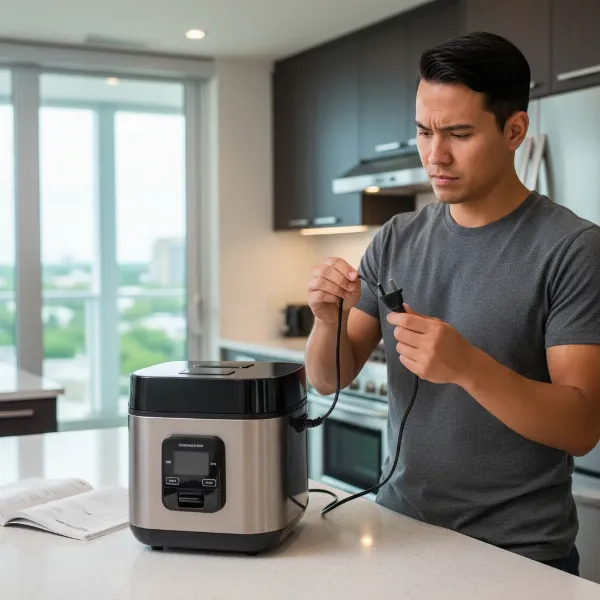 A person inspecting a rice cooker with no power, looking at the plug and cord, indicating troubleshooting for a rice cooker that won't turn on.
Step-by-Step Troubleshooting for a Non-Starting Rice Cooker
When your rice cooker remains stubbornly unresponsive, a systematic approach to troubleshooting can often reveal and resolve the issue. Before attempting any internal repairs or even touching electrical components, always ensure the appliance is completely unplugged from the wall outlet to guarantee your safety. This critical first step prevents any risk of electric shock and allows for safe handling during inspection. Taking a moment to unplug can make all the difference in a safe and successful repair attempt.
Check the Power Source
The most fundamental step is to verify that your rice cooker is receiving power from the wall outlet. This is often the easiest fix and should always be your starting point.
- Is it plugged in correctly? Begin by ensuring the power cord is securely inserted into both the rice cooker’s receptacle and the wall outlet. A loose connection at either end is a surprisingly common reason for a rice cooker not powering on. Give it a firm push to ensure it’s fully seated.
- Is the outlet working? To confirm the wall outlet is functional, plug in another small appliance that you know works, such as a lamp, a phone charger, or a toaster. If the other appliance also fails to work in that particular outlet, the problem lies with your household electrical system, not the rice cooker itself. Try another outlet in your kitchen or home.
- Check your circuit breaker: If multiple outlets in your kitchen are unresponsive, a tripped circuit breaker might be the culprit. Locate your home’s electrical panel and look for any breakers that are in the “off” or middle position. Flip the tripped breaker firmly to the “off” position, then back to “on” to reset it.
|
Our Picks for the Best Rice Cooker in 2026
As an Amazon Associate I earn from qualifying purchases.
|
||
| Num | Product | Action |
|---|---|---|
| 1 | BLACK+DECKER Rice Cooker 6-Cup (Cooked) with Steaming Basket, Removable Non-Stick Bowl, White |

|
| 2 | AROMA Digital Rice Cooker, 4-Cup (Uncooked) / 8-Cup (Cooked), Steamer, Grain Cooker, Multicooker, 2 Qt, Stainless Steel Exterior, ARC-914SBD |
|
| 3 | AROMA® Mini Rice Cooker, 2-Cup (Uncooked) / 4-Cup (Cooked), Grain Cooker, Soup Maker, Oatmeal Cooker, Auto Keep Warm, 1 Qt, Light Green |
|
| 4 | COMFEE' Compact Rice Cooker, 6-in-1 Stainless Steel Multi Cooker, Slow Cooker, Steamer, Saute, and Warmer, 2 QT, 8 Cups Cooked(4 Cups Uncooked), Brown Rice, Quinoa and Oatmeal, 6 One-Touch Programs |
|
| 5 | Instant Pot 4QT RIO Mini 7-in-1 Multi-Cooker, Pressure Cooker, Slow cook, Sauté, Steam, Rice Maker, Yogurt, & Warmer, Sea Salt, 4 Quarts |
|
| 6 | AROMA® Select Stainless® Rice Cooker, 3-Cup (Uncooked) / 6-Cup (Cooked), Stainless Steel Inner Pot, Small Rice Cooker, Auto Keep Warm, 1.2 Qt, White, ARC-753SG |
|
| 7 | COSORI Rice Cooker 10 Cup, 24h Keep Warm, Non-stick Ceramic Inner Pot, 18 Functions Fuzzy Logic Rice Maker with Stainless Steel Steamer Basket, Sauté, Slow Cooker, Black |
|
| 8 | Aroma Housewares 4-Cups (Cooked) / 1Qt. Rice & Grain Cooker (ARC-302NGBL), Blue |
|
| 9 | Zojirushi Micom 3-Cup Compact Size, Multiple Settings, Stainless Steel Made, Built-In Retractable Power Cord and Easy to Transport Rice Cooker and Warmer |
|
| 10 | AROMA® Mini Rice Cooker, 2-Cup (Uncooked) / 4-Cup (Cooked), Grain Cooker, Soup Maker, Oatmeal Cooker, Auto Keep Warm, 1 Qt, Milk Tea color |
|
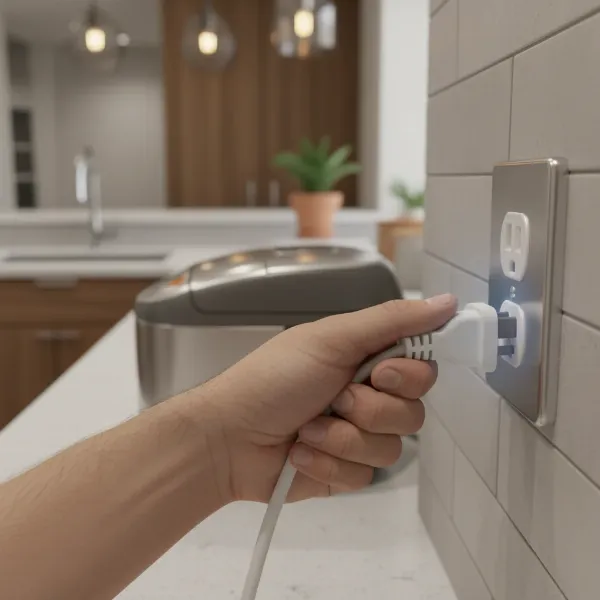 A close-up of a hand checking a rice cooker's power cord connection to an electrical outlet, emphasizing basic power troubleshooting.
Inspect the Power Cord
The power cord is the lifeline that delivers electricity to your rice cooker, making it a critical component to inspect when the appliance won’t turn on. Damage to the cord can interrupt the flow of power, rendering the cooker useless.
- Visible damage: Carefully examine the entire length of the power cord for any signs of physical damage. Look for cuts, fraying, exposed wires, kinks, or burn marks. Even minor damage can compromise electrical integrity and pose a safety risk.
- Secure connection to the cooker: If your rice cooker has a detachable power cord, ensure it is firmly connected to the appliance itself. Sometimes, this connection can become loose over time or with frequent movement, preventing proper power transmission.
- Replacement: If the power cord shows any signs of damage, it must be replaced immediately. Attempting to repair a damaged cord yourself without the proper expertise and tools can be extremely dangerous, risking electric shock or fire. It’s always safer to opt for a certified replacement cord specific to your rice cooker model.
Examine the Rice Cooker Components
Beyond the power supply, sometimes the issue preventing your rice cooker from turning on isn’t electrical but rather mechanical or related to specific safety features designed into the appliance. These checks are crucial for identifying non-power related causes.
- Inner pot seating: For the vast majority of modern rice cookers, the inner pot must be properly and securely seated within the outer housing for the heating element to activate. Ensure the pot is placed correctly and firmly presses down on the central heating sensor or heating plate. Misalignment can prevent the cooker from recognizing the pot and thus, from turning on.
- Lid closure: Many rice cookers incorporate safety mechanisms that prevent operation if the lid isn’t completely closed and latched. Check that the lid is fully shut and that any locking mechanisms are engaged. This prevents steam burns and ensures proper cooking conditions.
- Debris or spills: Take a moment to inspect for any food particles, dried rice, or liquid spills around the heating plate, temperature sensor (the small spring-loaded button in the center), or control buttons. These residues can interfere with sensors or switches, preventing the rice cooker from powering up or initiating the cooking cycle. A clean appliance operates more reliably.
- Overheating protection: If your rice cooker was recently used, particularly if it ran dry or overheated, a built-in safety mechanism might have been triggered. This protective feature automatically shuts down the appliance to prevent damage. Allow the rice cooker to cool down completely for at least 30 minutes before attempting to turn it on again.
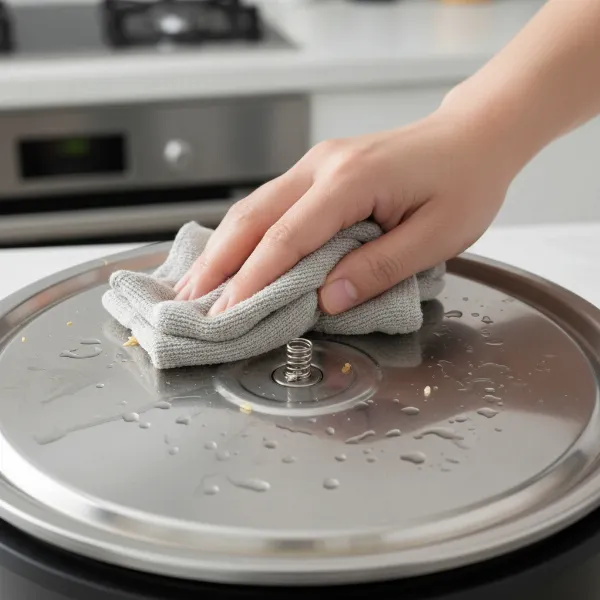 A hand cleaning the heating plate and sensor of a rice cooker, representing internal component examination and maintenance.
Resetting the Rice Cooker
Sometimes, electronic glitches or minor malfunctions can be resolved with a simple reset. This can clear temporary errors and allow the appliance to function normally again.
- Dedicated reset button: Certain rice cooker models feature a dedicated reset button, typically located on the underside or back of the unit. If your model has one, unplug the unit from the wall, press and hold the reset button for a few seconds, then release. Afterward, plug the cooker back in and attempt to turn it on.
- Hard reset: Even if your rice cooker lacks a specific reset button, a “hard reset” can often clear minor electrical issues. Simply unplug the rice cooker from the wall outlet and leave it disconnected for at least 5 to 10 minutes. This allows any residual electrical charge to dissipate and the internal circuits to reset. After the waiting period, plug it back in and try powering it on.
Internal Component Malfunctions
If external checks and basic resets don’t revive your rice cooker, the problem most likely lies within the internal workings of the appliance. Addressing these issues often requires a deeper understanding of electronics and, in many cases, professional expertise.
- Blown Thermal Fuse: This is one of the most common culprits for a rice cooker that has absolutely no lights or power. A thermal fuse is a safety component designed to blow (open the circuit) and permanently cut power if the cooker overheats beyond a safe operating temperature. Replacing it typically requires disassembling the unit to locate the fuse, testing its continuity with a multimeter to confirm it’s faulty, and then carefully replacing it with an identical part.
- Faulty Thermostat or Control Board: A malfunctioning thermostat can fail to correctly sense temperature, preventing the heating element from activating or the unit from powering on at all. In more advanced electronic rice cookers, a damaged control board can prevent the entire unit from receiving power or responding to commands. These issues usually necessitate professional repair, as they involve complex circuitry.
- Loose Switch Assembly: Over time, the main power switch or other internal switches (like the cook/warm selector) can become loose, corroded, or worn out. If the switch isn’t making proper electrical contact, the rice cooker will not turn on. Diagnosing this often requires opening the unit and inspecting the switch connections.
“Many users overlook simple power checks, jumping straight to costly replacements. Always start with the basics; often, the solution is right in front of you.” – Lan, Admin of ricecookerhot.com
When to Call for Professional Repair or Consider Replacement
Deciding whether to pursue professional repair or simply replace your rice cooker is a common dilemma that depends on several factors, including the complexity of the issue, the appliance’s age, and its initial cost.
- Safety concerns: If you observe any concerning symptoms such as burning smells, smoke, sparks, or unusual noises after plugging in the rice cooker, immediately unplug the appliance. Do not attempt to fix it yourself, as these are clear indicators of a serious electrical fault that poses a significant safety risk.
- Complex internal issues: Problems involving components like the main circuit board, a faulty thermostat requiring specialized calibration, or internal wiring issues often demand specialized tools, diagnostic equipment, and a deep understanding of appliance electronics to diagnose and fix safely. Unless you possess significant electrical repair experience and feel comfortable working with internal components, it’s always best to consult a qualified appliance repair technician.
- Cost-effectiveness: For older, basic rice cooker models, the cost of professional repair, including parts and labor, might unfortunately approach or even exceed the price of purchasing a brand-new unit. It’s wise to obtain an estimate for repair and then weigh that cost against the price of a suitable replacement, also considering the appliance’s expected remaining lifespan and warranty status.
- Age of the appliance: If your rice cooker is several years old and encountering its first major issue, especially an internal one, replacement might be the more practical and long-term solution. Newer models often offer improved efficiency, features, and updated safety standards.
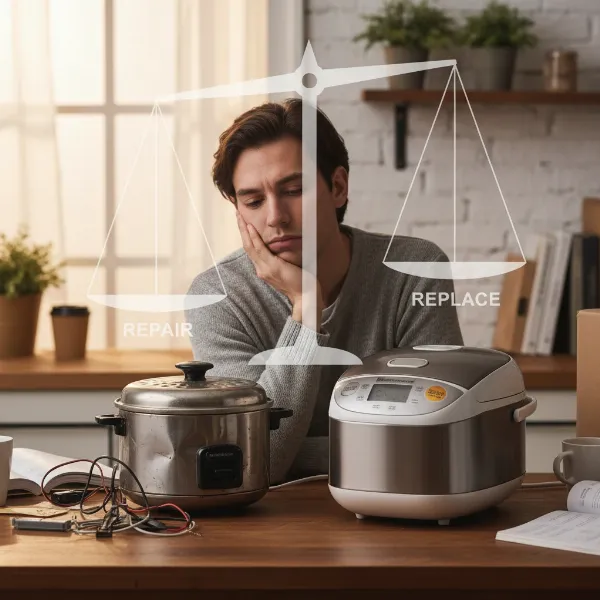 A person weighing options between fixing a broken rice cooker and buying a new one, symbolizing the repair vs. replacement dilemma.
Preventative Maintenance to Avoid Future Issues
Consistent and proper care can significantly extend the lifespan of your rice cooker and prevent many of the common power-related problems that lead to it not turning on. Integrating these simple maintenance tips into your routine will help ensure your appliance remains reliable.
- Proper cleaning: After each use, always thoroughly clean the inner pot, the lid, and especially the area around the heating plate and temperature sensor (the small spring-loaded button). Food residue, dried rice, or liquid spills can interfere with sensors, heating efficiency, and even create electrical issues over time. Ensure all parts are completely dry before reassembling and storing the rice cooker.
- Handle with care: Treat your rice cooker gently. Avoid dropping the inner pot, as this can damage its non-stick coating or deform it, affecting its contact with the heating element. Handle the power cord carefully, avoiding sharp bends, kinking, or pulling it out from the wall outlet by the cord itself. Always grasp the plug when disconnecting.
- Secure connections: Periodically check that both the power plug and, if applicable, the detachable cord connection to the appliance itself are snug and free of debris. A loose connection can cause intermittent power, generate heat, and eventually lead to complete failure.
- Use a stable power supply: In areas prone to frequent power fluctuations, surges, or brownouts, using a voltage stabilizer or a surge protector can significantly protect the sensitive electronics within your rice cooker. These devices help to regulate the incoming power, shielding your appliance from electrical damage.
Conclusion: A rice cooker that won’t turn on, while frustrating, often presents a solvable problem rather than an immediate need for replacement. By systematically checking the power source, thoroughly inspecting the cord, examining internal and external components, and attempting basic resets, you can frequently diagnose and resolve the issue yourself. Remember to always prioritize safety by unplugging the unit before any inspection or repair. Consistent preventative maintenance, including regular cleaning and careful handling, is also crucial for extending your rice cooker’s life and preventing future malfunctions. With these troubleshooting steps and a commitment to good care, you can bring your kitchen’s essential appliance back to life, ensuring perfectly cooked rice for many meals to come. What troubleshooting step will you try first to get your rice cooker working again?
Frequently Asked Questions
My rice cooker has power (lights are on) but won’t start cooking. What should I check?
If your rice cooker lights up but doesn’t initiate the cooking cycle, first ensure the inner pot is correctly seated and the lid is fully closed, as many models incorporate safety interlocks. Additionally, inspect for any accumulated debris on the heating plate or the central temperature sensor that might obstruct proper contact or accurate temperature readings.
Is it safe to replace a thermal fuse myself?
Replacing a thermal fuse can be a feasible DIY task for individuals with basic electrical knowledge and confidence in appliance repair. However, it necessitates disassembling the appliance and working with internal wiring. If you are uncertain about the process or uncomfortable handling electrical components, it is always safer and advisable to consult a qualified appliance repair technician to prevent potential hazards.
Can a rice cooker stop working due to a power surge?
Yes, a sudden power surge can indeed damage a rice cooker’s delicate internal components, such as the thermal fuse, control board, or other electronic circuits, leading to a complete failure to turn on. Employing a surge protector or a voltage stabilizer can provide a crucial layer of defense against such unpredictable electrical fluctuations, protecting your appliance.
My rice cooker makes a strange noise (e.g., hum, click) but doesn’t turn on. What could that mean?
A strange noise like a hum or click when attempting to turn on your rice cooker often indicates that the appliance is receiving some power but is failing to fully engage its primary functions. This could suggest a faulty power switch, a heating element struggling to activate, or an issue within the control board or internal relay. If you hear such sounds, immediately unplug the unit and consider professional inspection to identify the exact cause.